The Mechanics of Stability: Engineering Against the Forces of Cryogenic Displacement
How to manage frost heave in hardscapes the resilience of a hardscape—whether a residential patio, a commercial plaza, or an architectural walkway—is measured not by its appearance on the day of installation, but by its capacity to endure the relentless cycles of seasonal climate change. Among the environmental forces acting upon built environments, none is as destructive or as misunderstood as frost heave. This phenomenon, driven by the expansion of freezing pore water in the subgrade, exerts upward pressures capable of fracturing reinforced concrete, displacing heavy stone masonry, and rendering precise geometric alignments obsolete within a single winter season.
The challenge of engineering against cryogenic displacement is fundamentally a challenge of moisture control. When soil saturated with water transitions into a frozen state, the ice crystals expand, creating internal mechanical forces that seek the path of least resistance. If that path is upward, the surface material moves with it. To address this, one must move beyond the basic requirement of a compacted base and into the realm of thermodynamics, soil mechanics, and site-specific hydrology. Achieving a stable installation requires a sophisticated grasp of why soils heave and, more importantly, how that energy can be dissipated or diverted before it reaches the surface.
This discourse provides a comprehensive framework for managing the subterranean dynamics that threaten hardscape longevity. It is intended for professionals and property managers who recognize that the foundation of high-performance architecture lies in the unseen details. By analyzing the interaction between substrate composition, thermal conductivity, and structural design, we explore the methodology required to maintain structural alignment in regions susceptible to deep, persistent freezing.
Understanding “how to manage frost heave in hardscapes”
To understand how to manage frost heave in hardscapes, one must move away from the reductive view that “compacted aggregate” is a universal panacea. Frost heave is an expression of soil physics, specifically involving the migration of capillary water toward the freezing front. When the subsurface soil has high capillary potential—common in silts and clays—it will actively draw water upward from the water table, creating ice lenses that expand as the temperature drops. Therefore, the goal is not merely to “resist” the heave with weight, but to eliminate the conditions that allow ice lenses to form.
A common misunderstanding is the belief that placing a thick layer of crushed stone will automatically stop all movement. While base depth is critical, if that base is situated over native soil that is highly frost-susceptible and lacks a drainage exit, the base itself becomes a bathtub, collecting water and facilitating the very failure it was intended to prevent. True mastery over this process requires a synthetic approach: identifying the soil type, managing the groundwater level, and insulating the foundation to maintain a thermal buffer.
Deep Contextual Background
How to manage frost heave in hardscapes the historical approach to hardscape construction often prioritized speed over long-term geotechnical stability. Before the widespread adoption of geotextile engineering and structured aggregate bases, builders relied on localized experience—which frequently failed when unusual weather patterns occurred. As urban density increased, the footprint of impervious surfaces grew, drastically altering local drainage pathways.
Today, we view the hardscape not as an isolated slab, but as part of a larger hydrological system. The evolution of our understanding is marked by the transition from “strength-based” design (making things heavy enough to stay put) to “drainage-based” design (removing the water before it can freeze). This evolution is critical in northern latitudes where the “frost depth”—the distance to which the ground freezes—can vary significantly depending on microclimate, building proximity, and surface reflectivity.
Conceptual Frameworks and Mental Models
-
The Thermal Front Model: Imagine the ground as a thermal gradient. The frost line moves downward in autumn and upward in spring. Any structural element that spans across this moving front is subjected to shear forces.
-
The Capillary Draw Model: Soils are not static; they act as pumps. Silt particles are the most efficient at pulling water upward. Identifying these “high-draw” soils at the site analysis phase is the most effective way to prevent failure.
-
The Hydraulic Exit Strategy: Every subsurface base must have a “low point” exit. If water cannot physically leave the base layers, it will eventually cause movement.
-
The Insulation Barrier: By using extruded polystyrene (XPS) board or similar materials, we can artificially deepen the “frost line” below the hardscape, effectively keeping the substrate above freezing temperatures.
Key Categories of Mitigation and Substrate Engineering
Decision logic should follow the “Hierarchy of Controls”: First, ensure gravity-based drainage; second, substitute susceptible native soil with inert base aggregate; third, incorporate thermal mitigation if the structure is sensitive to even minimal displacement.
Detailed Real-World Scenarios How To Manage Frost Heave In Hardscapes
-
The Clay-Soil Walkway. In a region with heavy clay, the site cannot drain. Even with a thick aggregate base, the clay acts as a bowl. The failure mode: The aggregate base becomes saturated, and the clay heaves the entire system upward. The correction: Installation of a subsurface perimeter drain tile and a thick geofabric separation layer to prevent “fines migration” where clay infiltrates the stone base.
-
The Transition Zone. A patio meets a concrete garage foundation. The garage foundation is deep (below the frost line), while the patio base is shallow. The failure mode: Frost heave lifts the patio, but the garage remains stationary, resulting in a shearing crack at the threshold. The solution: An expansion joint paired with a deepened, insulated footing at the transition.
-
The Variable Frost Line. The sunny side remains warmer; the shaded side freezes deep. The failure mode: Differential heaving across the plaza. The solution: Uniform insulation density across the entire structure to equalize thermal conductivity.
Planning, Cost, and Resource Dynamics
The economic argument for rigorous frost management is found in the “Cost of Failure.” Fixing a heaved stone terrace often requires complete demolition of the hardscape, re-excavation, and replacement of the base material—effectively doubling the project cost.
Tools, Strategies, and Support Systems
-
Dumpy Levels/Laser Levels: Essential for verifying that the subgrade slopes toward the drainage exit.
-
Geotextile Fabrics: Non-woven fabrics used to maintain the separation between the aggregate base and the native soil.
-
Clean-Out Ports: Integrated access points in subsurface drainage systems to allow for annual flushing.
-
Extruded Polystyrene (XPS): High-compressive-strength insulation for thermal control.
-
Perforated Pipe (ADS/Corrugated): The artery of any subsurface drainage system.
Risk Landscape and Failure Modes How To Manage Frost Heave In Hardscapes
Frost heave risks are rarely isolated. They are compounding:
-
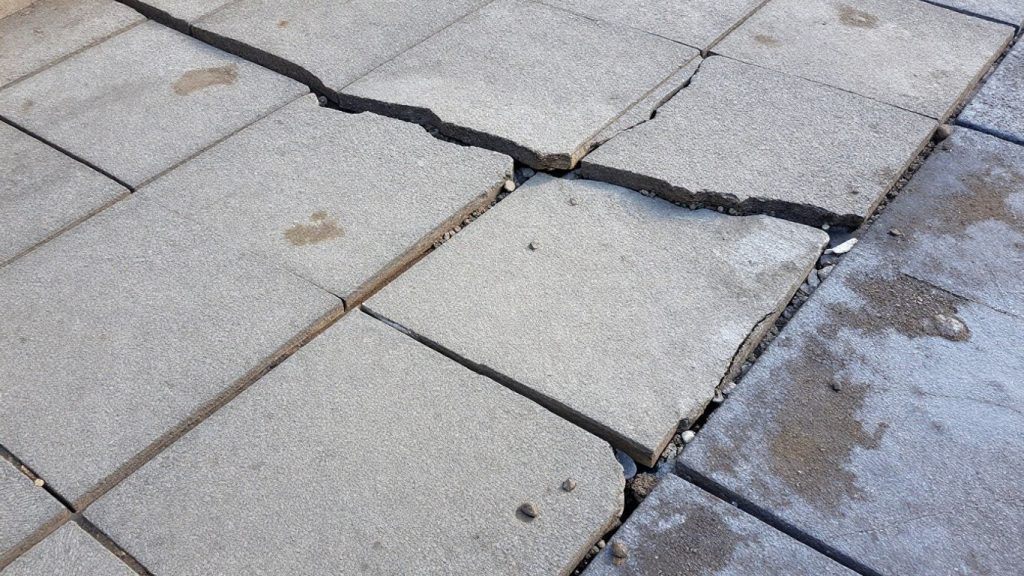
Differential Heave: The most aesthetically and structurally damaging failure, where different sections of the hardscape move at different rates, leading to jagged edges, tripped surfaces, and misaligned joints.
-
Silt Infiltration: Over time, if the separation layer is absent, fine-grained native soil migrates upward into the aggregate base, destroying its drainage efficiency and making the base frost-susceptible.
Governance and Long-Term Adaptation
A structured monitoring program for how to manage frost heave in hardscapes includes:
-
Annual Spring Audit: Inspection of all joints and threshold transitions after the final thaw to identify “leftover” displacement.
-
Drainage Flush: Annual maintenance of clean-out ports to ensure the subsurface tile system remains clear of sediment.
-
Threshold Monitoring: Documenting the relationship between the hardscape and fixed structural elements (like door sills) over a 5-year cycle to detect slow-onset “heave creep.”
Measurement, Tracking, and Evaluation How To Manage Frost Heave In Hardscapes
-
Leading Indicators: Standing water in landscape beds adjacent to the hardscape; evidence of soil saturation near the perimeter.
-
Lagging Indicators: Visible buckling in paver patterns; widened joints; uneven steps; cracks in rigid concrete sections.
-
Documentation Example: Maintain a “Geotechnical Site Log” noting the soil type (e.g., Silty-Clay), the estimated depth to seasonal groundwater, and the final structural design specifications used to handle the anticipated frost depth.
Common Misconceptions and Oversimplifications
-
“Crushed stone base prevents frost.” Stone only provides drainage; if the water can’t leave, the stone will hold it, and it will heave.
-
“Hardscapes are just about surface materials.” The surface is the finish; the engineering is in the bottom 24 inches.
-
“Sand is a good base.” Sand is highly frost-susceptible in many cases because it can retain moisture through capillarity; clean, crushed, angular stone is vastly superior.
-
“It only heaves in extreme cold.” Repeated freeze-thaw cycles (the “shoulder seasons”) are often more destructive than a sustained deep freeze.
-
“Rigid is better.” In cold climates, a degree of flexibility in modular systems is a major advantage over rigid, monolithic slabs.
Conclusion How To Manage Frost Heave In Hardscapes
Engineering for longevity in environments prone to cryogenic activity is an exercise in managing the flow of energy and water. Mastering how to manage frost heave in hardscapes demands an analytical mindset that refuses to treat the ground as a static entity. By focusing on subsurface drainage, soil separation, and thermal regulation, professionals can construct hardscapes that remain stable, safe, and aesthetically refined despite the seasonal expansion and contraction of the earth.